Unpanic.Visual journal
Little illnesses, clearly explained

Bronchiolitis in Babies: What to Expect and When to Get Help

Bronchiolitis often begins like a cold, then affects breathing and feeding. Symptoms can be at their worst around days 3 to 5, but every baby’s course is different. Here is what to watch for and when to seek help.

General education, not a diagnosis. Do not wait for a stage in the guide if your child is getting worse.

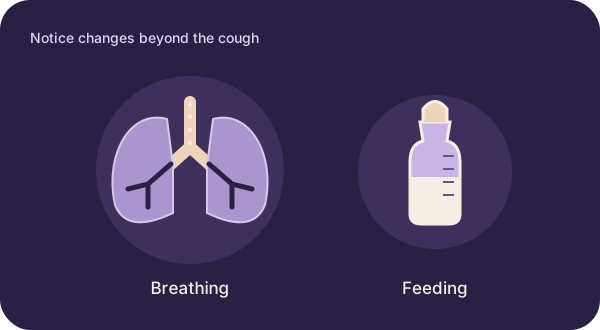
A schematic pair of lungs and a feeding bottle illustrates breathing and feeding, two things to observe during bronchiolitis. The lung drawing is not to scale, does not show an individual baby and does not measure severity.
Breathing and feeding: two changes to notice · Schematic, not a measure of severity
01 / The usual course

The usual course

Beginning

Cold-like beginnings

Bronchiolitis is a viral chest infection in babies and children under 2. It often starts with sneezing, a runny or blocked nose, and a slightly raised temperature. These early signs can look much like an ordinary cold; by themselves, they do not tell you how the illness will develop. Respiratory syncytial virus, or RSV, is a common cause, and viruses spread easily through coughs and sneezes. The timeline is a guide to a possible pattern, not a set of deadlines. [1]

Changing symptoms

Breathing and feeding may change

As the illness develops, a baby may cough, breathe more quickly, feed less easily, or make wheezing or crackling sounds while breathing. Irritability can also occur. Notice the whole picture: breathing effort, feeding, wet nappies, temperature and how alert your baby seems. Symptoms can overlap rather than arrive in a neat order. A noisy breath alone does not establish how serious the illness is; changes in effort, pauses, colour or alertness matter too. [1]

Often hardest

A commonly harder stretch

Symptoms are usually worst between days 3 and 5. That is a common pattern, not a promise about any one baby, and it does not mean you should wait if your baby is worsening or showing warning signs. A cold that is getting worse, much less feeding, dehydration signs, unusual tiredness or a temperature meeting the thresholds below calls for urgent medical advice. Babies under 6 months and some babies with particular health or birth histories have a higher risk of becoming seriously ill. [1]

Improving

Gradual improvement

Bronchiolitis usually gets better on its own, and the cough usually improves within 3 weeks. This is a usual course, not a guaranteed recovery date; symptoms and needs differ. Keep paying attention to breathing, feeds and wet nappies while the cough settles. There is no specific treatment for bronchiolitis, and some children need hospital care. If your baby seems seriously unwell, trust your judgement and seek help rather than relying on the timeline. [1]
02 / How it is diagnosed

How it is diagnosed

A clinician looks at the whole picture

Assessment may include asking when symptoms began and whether a cold is worsening, how breathing looks and sounds, and how much your baby is feeding. They may also want to know about wet nappies, temperature, alertness and whether your baby seems unlike themselves. These details help guide assessment; this guide cannot diagnose bronchiolitis or judge your baby’s breathing from a description. [1]

Age and health history matter

Tell the clinician your baby’s age and whether they were born very prematurely, have a heart or lung condition, or have a weakened immune system. Babies under 6 months and children with these factors have a higher risk of serious illness. A clinician can assess the current symptoms in that context. A baby’s risk history does not, on its own, say how severe today’s illness is. [1]

Similar sounds do not settle the question

Bronchiolitis is different from bronchitis. Bronchitis causes a cough with lots of mucus and can affect people of all ages. Wheezing or crackling can occur in bronchiolitis, but a sound alone is not enough to confirm the cause or assess seriousness. If breathing is difficult, there are pauses, or your baby looks blue or grey, act urgently rather than trying to identify the illness at home. [1]

03 / Symptoms that can look similar

Symptoms that can look similar

Is this still a cold-like start, or is it worsening?

Sneezing, a runny or blocked nose and a slightly high temperature can be early bronchiolitis signs. Ask for urgent medical advice if your baby has had a cold and it is getting worse, or if feeding has dropped markedly. A clinician can ask how symptoms have changed over time; the early resemblance to a cold does not rule out bronchiolitis. [1]

How are breathing and feeding changing?

A clinician may ask about faster breathing, wheezing or crackling, feeding difficulty, and whether your baby is taking much less than usual. They may ask when the last wet nappy was: a dry nappy for 12 hours or more, or other dehydration signs, needs urgent advice. These questions help assess the situation; no single answer here can diagnose the cause. [1]

What are the temperature, alertness and health history?

Tell the clinician your baby’s measured temperature, how alert they are, and whether they feel unusually hot or cold or are shivering. Urgent advice is needed for a temperature of 38°C or higher in a baby under 3 months, or 39°C or higher in a baby older than 3 months. Age, very premature birth, heart or lung conditions, and a weakened immune system are also relevant to assessment. [1]

04 / When to get help

When to get help

Keep reading. Keep track of what changes.

Sources and review

AI-assisted draft based on the sources below. Stages may overlap and duration varies.

Clinical and language review pending.

  1. Bronchiolitis - NHS
    Retrieved 2026-09-30